UCAS Points Calculator
Add your grades from any mix of qualifications. Your UCAS Tariff total updates as you go, and we tell you which courses it puts in range. Free, and built on the official 2026 Tariff.
Your qualifications
Pick a grade for each one. The total updates as you go.
– points
– points
– points
Checked against the official UCAS Tariff Reviewed by Dr. Lila SharmaUpdated 22 April 2026
Official 2026 Tariff
Every grade value comes straight from the official UCAS Tariff, and is checked by an automated audit.
Any mix of qualifications
A-levels, BTEC, Highers, IB, T-Levels, EPQ and more, added up on one scale.
Plain English
We give you the number, then say what it actually means for university.
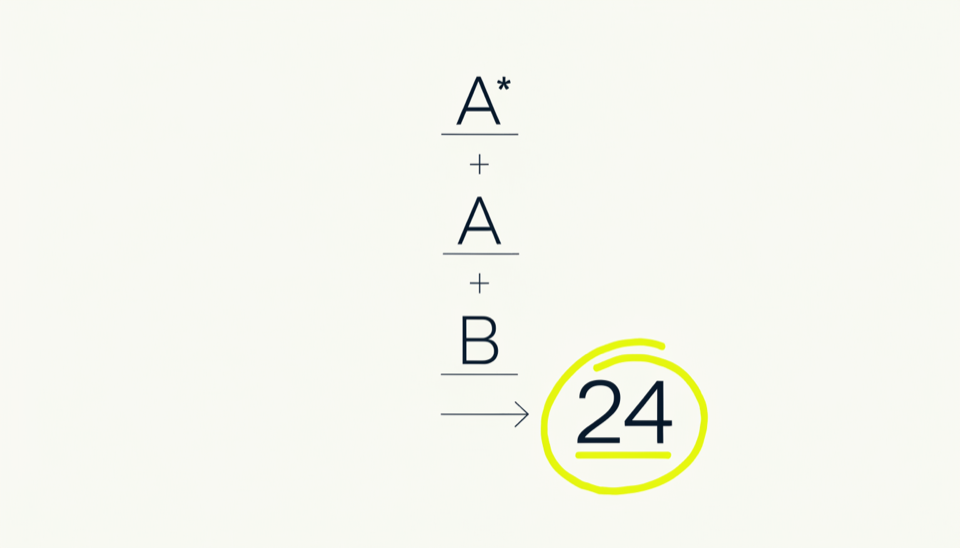
Quick answer: A UCAS points calculator adds up the Tariff value of your Level 3 grades into one total. An A* is 56 points, an A is 48, a B is 40. Add each qualification — A-levels, BTEC, Highers, IB and more — and your total updates instantly.
The calculator above does all the adding for you. Add a row for each qualification, pick your grades, and watch your total update live — built on the official 2026 UCAS Tariff. Then find out exactly which courses are in range. Studying a mix of qualifications? No problem — add each one and we'll total them for you.
How to calculate your UCAS points in 30 seconds
You don't need a spreadsheet or any maths. Here's the quick version:
- Pick your qualification from the first dropdown — A-level, BTEC, Scottish Higher, IB, EPQ, and more are all there.
- Choose your grade or size in the next dropdown. The grade options change to match the qualification you picked, so you only ever see valid choices.
- Add another row for each extra qualification. Your running total updates the moment you change anything — no submit button needed.
That's it. The big number at the top is your points total. If you want the full method behind the numbers, here's how UCAS points are calculated, step by step.
How many UCAS points is each grade worth?
Every Level 3 grade has a set Tariff value. The higher the grade and the bigger the qualification, the more points it carries. Here are the headline numbers across the most common qualifications, with full tables one click away.
| Qualification | Top grade | Points |
|---|---|---|
| A-level | A* | 56 |
| A-level | A | 48 |
| A-level | B | 40 |
| A-level | C | 32 |
| BTEC Extended Diploma | D*D*D* | 168 |
| BTEC Extended Diploma | DDD | 144 |
| Scottish Higher | A | 33 |
| Advanced Higher | A | 56 |
| IB Higher Level | H7 | 56 |
| T-Level | Distinction* | 168 |
| EPQ | A* | 28 |
A-level grades move in steps of 8: A* is 56, A is 48, B is 40, C is 32, D is 24, E is 16. That neat pattern makes it easy to see how each grade adds to your total.
Want the complete grade-by-grade breakdown for your qualification? See the full A-level points table, the BTEC points table, the Scottish Highers table, or the IB points table.
Calculators for each qualification
The calculator above handles everything at once, but if you want a focused tool for a single qualification — with its own worked examples and the full table on the page — we've built one for each:
- A-level calculator — the most-used tool, A* to E
- BTEC calculator — Extended Certificate, Diploma and Extended Diploma
- Scottish Highers calculator — and the Advanced Highers calculator
- IB calculator — Higher Level, Standard Level and core
- T-Level calculator — Pass to Distinction*
- EPQ calculator — adds to your A-level total
- Mixed qualifications calculator — for any combination
Pick the one that matches what you're studying, or just keep adding rows above to total a mix.
Studying a mix of qualifications? Add them all
This is more common than you'd think, and it's completely normal. Plenty of students take, say, a couple of A-levels alongside a BTEC, or an A-level plus an EPQ. The Tariff was designed to handle exactly that — every qualification sits on the same points scale, so they add up cleanly.
For example, two A-levels at grade B (40 + 40 = 80) plus a BTEC Subsidiary-style top-up, or an A-level A (48) with an EPQ at A* (28) gives you 76 points from just those two. Add each row above and we'll total them for you. For the detail, see how to combine A-level and BTEC points or read whether you can mix qualifications.
What are UCAS Tariff points, exactly?
UCAS points are just a way of putting different qualifications on the same scale. Instead of comparing apples (A-levels) with oranges (BTECs or Highers), every Level 3 grade is given a number — its Tariff value — so universities can talk about all of them in one language.
Here's what's worth knowing in plain English:
- Only Level 3 qualifications count. A-levels, BTECs, Highers, the IB, T-Levels, EPQs and similar all carry points. GCSEs (Level 2) don't.
- Bigger and higher scores more. A full A-level is worth more than an AS-level; an A* beats a B.
- Your total is just the sum. Add the value of every qualification you're counting, and that's your UCAS points total.
- The Tariff updates over time. We use the official 2026 values throughout, so the numbers you see here are current.
If you'd like the friendly deep-dive, read what UCAS points are, in plain English or what the UCAS Tariff is.
Do all universities use UCAS points?
Many universities and courses do work in UCAS points, especially for offers like "112 points from three A-levels". But others — including a lot of Russell Group courses, plus most medicine, dentistry and law offers — ask for named grades (for example, "AAA including Chemistry") rather than a points figure. Neither approach is better or worse; they're just different ways of setting the bar.
So treat your points total as a really useful guide for comparing courses and spotting what's in range — then confirm the precise requirement on the course page before you apply. And no, GCSEs don't count for UCAS points, though some courses still ask for certain GCSE grades separately. You can read more on which universities use UCAS points.
What is your points total worth? Courses and offers in range
Once you've got your number, the next question is the important one: what does it actually open up?
Here's a worked example. Say you're taking three A-levels and you're on track for ABB. That's 48 + 40 + 40 = 128 points. A total of 128 is comfortably in range for a huge number of courses — plenty of business, psychology, sports science and humanities degrees ask for around 112 to 136 points. It would be below the typical medicine offer, which usually wants specific top grades, but in range for many strong universities.
That's the value of having one clear number: you can quickly see what's realistic and where you'd be stretching. To go deeper, check how many UCAS points you need for university, explore what you can study with your points, look at subject-specific bars like UCAS points for nursing, or see exactly what 112 points can study.
Common grade combinations and their points
It helps to know where the popular A-level combinations land. Here are the totals for three A-levels:
| Grades | UCAS points |
|---|---|
| AAA | 144 |
| AAB | 136 |
| ABB | 128 |
| BBB | 120 |
| BBC | 112 |
| BCC | 104 |
| CCC | 96 |
| BTEC DMM | 112 |
Each step between combinations is small, which is reassuring — one grade up or down rarely changes your whole picture. Explore the detail for AAA UCAS points, BBB UCAS points, ABB UCAS points, or the DMM BTEC UCAS points breakdown.
Not enough points? Your realistic next steps
First, take a breath — being a little short is far more common than you'd think, and it's rarely the end of the road. If your total isn't quite where you need it, you have real, practical options:
- Clearing — thousands of courses with places available, many in range for your exact points total. Our UCAS points for Clearing guide shows how to find them.
- Contextual offers — some universities lower their requirements based on your background. Worth checking before you assume a course is out of reach.
- Retakes or a top-up qualification — an extra qualification can close a small points gap. See how to get more UCAS points.
- Adjustment and a calm plan for the day — knowing your options before results day means no scrambling.
Don't panic — there are realistic routes here, and we'll help you find the one that fits. Start with what to do with not enough UCAS points and the A-level results day 2026 guide so you're ready, not caught out.
Grades from outside the UK? Convert them to UCAS points
If your qualifications aren't from the UK, you still get a straight answer. Many international qualifications map onto the UCAS Tariff, so you can see roughly what your grades are worth here and compare courses on the same scale.
For example, the International Baccalaureate converts neatly — an IB Higher Level 7 is worth 56 points, the same as an A-level A*. Other systems, from Indian boards to the German Abitur, each have their own conversion. Start by learning how to convert your grades to UCAS points, or jump straight to IB to UCAS points or Indian grades to UCAS points. Once you've got your converted figures, add them to the calculator above.
Sorted your place? Helpful next steps
*Helpful next step — once your place is sorted, here's what tends to matter next.*
If you've got your offer and you're looking ahead to starting university, a few practical bits are worth sorting early: the best student bank accounts (many come with handy freebies), a clear student accommodation guide, and the student finance basics so the money side isn't a mystery. No rush — these are just the genuinely useful things to tackle once the hard part is done.
UCAS points: quick answers
How do I calculate my UCAS points? Add up the Tariff value of each Level 3 grade. An A-level A* is 56 points, an A is 48, a B is 40. Pop each qualification into the calculator above and your total updates live — no maths needed.
How many UCAS points is an A? An A-level grade A is worth 48 UCAS points. An A* is 56, a B is 40, a C is 32. AS-level grades are worth less — an AS grade A is 20 points.
How many UCAS points do you need for university? It depends on the course. Many ask for around 96 to 144 points (roughly CCC to AAA at A-level), but plenty sit higher or lower. Check what your total is in range for with how many points you need.
Do GCSEs count for UCAS points? No — GCSEs don't carry UCAS Tariff points. The Tariff only covers Level 3 qualifications. That's normal, and many courses still ask for certain GCSEs separately.
Do all universities use UCAS points? No. Some courses ask for specific grades instead. The Tariff is one common way to compare, but always check each course's exact requirements.
Bookmark this for results day
Save this page now so your calculator is one tap away when grades land. Share it with a friend who's stressing, too — one clear number helps everyone breathe easier.
See the UCAS key dates for 2026Frequently asked questions
Sources
Checked against official sources on 25 June 2026. Always confirm exact requirements on the university's own course page.